
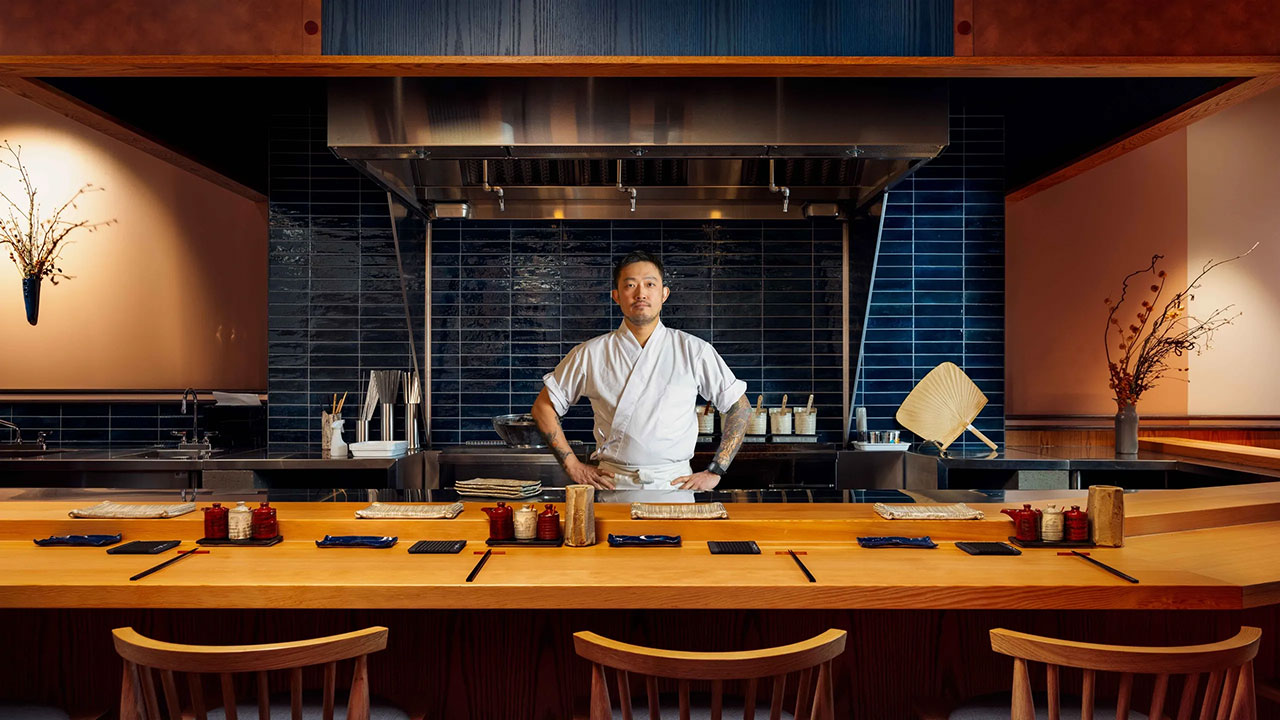
Vancouver’s dining scene reached another milestone this October as Sumibiyaki Arashi earned its first Michelin star, while Published on Main successfully maintained its standing among the city’s top restaurants. Both kitchens share a common foundation: each was designed and built by Foundry Kitchens, whose craftsmanship continues to support Vancouver’s most celebrated culinary teams.
For Foundry, this recognition is both a celebration and a reminder of what drives its work: translating a chef’s creative vision into a high-performance kitchen that feels effortless in motion. From the glow of binchotan to the polish of custom stainless steel, these kitchens are where artistry meets engineering.
Sumibiyaki Arashi wins a Michelin Star
Inside the understated, 14-seat counter of Sumibiyaki Arashi, Chef Pete Ho serves an omakase experience that has redefined yakitori in Vancouver. Michelin called his work “uncomplicated yet profound,” but the path to that simplicity demanded extraordinary precision behind the scenes.
Foundry designer Haifeng Wang worked with Chef Pete to map out the service flow.
“He was trained in Japan and wanted to stay true to the yakitori method,” Haifeng recalls. “That meant charcoal, not gas or infrared. Our challenge was to make that possible here under various local codes.”
Navigating Vancouver’s restrictions on solid-fuel cooking required careful calculations on airflow and compliance. Foundry’s team evaluated several ventilation systems that met regulations while maintaining authenticity, which required cooking to be done in front of guests and in the dining room.
The result is a kitchen that feels both modern and traditional: compact, seamless, and carefully arranged around the chef’s workflow. Every counter height, shelf depth, and reach zone was adjusted to fit the staff who use it daily.
“We put a lot of emphasis on personalization,” Haifeng says. “Staff height and arm reach translate into shelving height and counter depth. “The easier it is to use, the more it gets used. The goal is to make the kitchen truly a space for the operator.”
What diners see is an elegant open grill. What they don’t see is the innovation that made it possible.
Published Maintains Michelin Rating
A few blocks away, on Vancouver’s Michelin Mile, another Foundry project continues to earn accolades. Published on Main, which earned its Michelin Star in 2022 and retained it in 2025, showcases an entirely different approach to restaurant kitchen design.
Foundry designer Dara Nel-McIntosh remembers the space as one of the most technically demanding kitchens she has ever designed.
“The kitchen is in the basement, long and narrow with low ceilings,” she says. “Even getting the right hood was a puzzle.”
With ceiling heights limiting options, Foundry worked with manufacturer Spring Air to engineer a custom hood system that delivered high performance within minimal clearance. Equipment placement became a careful exercise in ergonomics and flow. To maximize efficiency in a compact space, the kitchen followed a linear flow with a small staging area located opposite the cookline for plating and pickup. The garde-manger upstairs links to the main line through a narrow stairwell. Despite its size, the kitchen performs with precision and ease.
When the custom heated pass revealed uneven heat during early service, Foundry brought it back to the shop for testing and re-engineering.
“We added an aluminum sub-top, tested it, and it worked beautifully,” Dara says. “That modification became a new standard design option for us.”
Every challenge became an opportunity to innovate.
“To perform consistently every night, the kitchen has to feel like muscle memory,” Dara explains. “Our goal is to remove friction so chefs can focus on the food.”
Foundry’s One-Team Approach to Restaurant Kitchen Design
What connects these restaurants beyond Michelin recognition is Foundry’s fully integrated approach to commercial kitchen design. The company’s design, fabrication, and equipment teams work together from start to finish, ensuring that every idea on paper performs flawlessly in steel.
Sales consultant Jesse Deggan describes himself as the “common thread” through each project.
“There aren’t any kitchen contractors with design teams like ours,” he says. “Having everything under one roof means we eliminate the gap between what’s drawn and what’s built. My job is to make sure every design intent is carried through to the site and translated accurately.”
This continuity enables Foundry to anticipate issues early, from plumbing and electrical locations to seamless transitions between elements, ultimately resulting in a thoughtful, uninterrupted space.
Founded in 2001, Foundry Kitchens has evolved from a local equipment supplier into a full-service foodservice design and stainless-steel fabrication firm serving clients across North America. The company’s success lies in its ability to combine creativity, technicality, and precision craftsmanship, enabling chefs to bring their ideas to life.
Photos: Conrad Brown